Sunday, November 3, 2013

The Cane Cutters

My love of chickens and my love for the Island of Hispaniola blossomed at the same time. Farming in New England afforded me a bit of time to travel during the winter and I fell madly in love with the Dominican Republic.  My passion to share a vision in creating a world where we connect with and treat our “food” in a dignified way followed me in my travels. On the Island, I saw on the outskirts of the cane fields the real cost of our sugar through the inhumane conditions in which these workers were subjected.
Segregated in the Batey, the shanty towns where the Haitian Cutters and their families lived, I learned the land and animals are not only ones who suffer in our cold and ruthless quest for cheap food.

This summer, as part of the ongoing, centuries old tensions between the Dominican and Haitian governments, the Dominican Supreme Court ruled to revoke the citizenship of all Haitians immigrants who could not prove their legal status all the way back to 1929.
This has left the children, grandchildren and great grandchildren of the cane cutters without a country. Born, raised and living in the Dominican Republic, these children of Haitian decent have not rights, no legal way to travel, marry, work or receive an education and as of now, no hope for their future.

Many friends and colleagues have been forwarding me articles speaking to the International outrage over this ruling. The solution being put forth by many in the International community is to boycott travel to the DR and places the blame for the situation solely on the Dominicans. This is not only unfair to the average Dominican citizen, it is unwarranted and continues to absolve the responsibly every one of us plays in this horrific human condition. 

The Dominican government is faced with limited resources on a small Island with millions of people and an extremely unstable situation in bordering Haiti. It does not solely own the cane fields, nor due the resort employees who will be the first to suffer with any kind of significant travel boycott. The Dominican Government is not to blame for the economic reality that sugar that is only available to us through the abuses and inhumane treatment of the workers who cut the cane.

They play part their part, but so do all of us.

As long as we continue to demand full shelves with every imaginable food, at every moment of every day at a hugely subsidized cost, these moral violations of all living beings will continue. Relying on corporations, who are driven only by profit, to provide us with our food, will guarantee the continuation of the atrocities to our land, our animals and our fellow human beings. People are designed to care, but we care in small intimate settings. When we lose a direct connection to our food, we lose our ability to care.


Eating and buying local affords us the opportunity to support a size community for which we can care. Those foods which cannot be supported with the local community should be expensive, rare and hard to obtain. Cheap food, grown harvested, and butchered far away from our everyday experience has made us forget how labor intensive and difficult it is to produce and distribute.


The cane cutters are only one example of the hidden costs in our food. Behind the scenes of this inexpensive commodity is essentially slavery. It always has been.  The plight of the Haitians in the Dominican Republic is not because of a barbaric government, but rather a barbaric world.

We live in a world where we continue to turn a blind eye to our moral compass in our demand for the cheap abundant selection on our grocery shelves.  If we really care about the Haitian sugar cane workers in the Dominican Republic, or the hens in the layer factories, then the change needs to start with us, and our expectations and relationship with our  food.

Tuesday, June 4, 2013

Proudly Sewn in the Dominican Republic

What better place to produce such a whimsical and fun product then among the big smiles and island music of the Dominican Republic. A look behind the scenes of the chicken attire production reveals a mission of social change and meaningful employment to a group often overlooked and under-served, the women of Puerta Plata!


Nestled in between the mountains and the sea, Puerta Plata is home to beautiful beaches, bustling commerce and bountiful agriculture. Behind the scenes of this perfect climate, picturesque pasture, and spectacular coastline, live the unnoticed women- the widows, single mothers, and the undocumented descendants of the sugar cane workers, immigrants who have crossed the mountains in hopes of finding a better life, escaping the barren land and desperate poverty of Haiti.


I came to the island years ago as most do, to relax and enjoy the luxuries of the resorts. However, as glorious as the resorts are, it was the people, their music, their smiles, their outlook, who made a lasting impression.  The island is welcoming, warm, fun, and full of love. Venturing outside of the resorts opened up a whole new world for me- a world of lasting friendships, epic adventures, and a love for dancing Merengue.


Despite the magic of the tropical paradise, there is no denying the desperate poverty which surrounds far too much of the population. Connivance's America’s poor take for granted such as flushing toilets, running water and reliable electricity are luxurious for only a few. In stark contrast to the endless all you can eat buffets of the resorts, the children of the hotel workers are living on meals of rice, beans and salami.


While listening to friends, volunteers, and ex-pats discuss the woes of the island late into the night, the reoccurring theme was always "no jobs"…the lack of well-paying steady jobs. As a lifelong entrepreneur I always had a dream I would be able to give back to an island that had given me so much and these conversations planted a seed which over the last few years has begun to grow.

Pampered Poultry was born almost by accident; it has blossomed through a collective passion for poultry shared by our customers and by our society’s growing interest in backyard chicken keeping and a collective desire to share in the local food movement and a need to be closer to our food, healthy and more in harmony with nature.

As the business grows here in this country, it has also afforded the opportunity to include the women whom I had met and promised to help on the island. Diana, the owner of Suncamp, and a tireless supporter of the Haitian community in Munoz, has been a partner is getting the idea for a sewing co-op off the ground. She has generously opened her apartments for sewing space, shared her connections in the community and through her foundation has helped to start what we hope will on day grow into a self-sustaining organization that offers it members good pay  and educational opportunities for their children and grandchildren.


Right now the group is small, 6 dedicated women, 3 Dominicans and 3 Haitians working side by side. Pampered Poultry is the primary client, but we are working on bringing other companies into the co-op. We are also supporting the women and their children by offering our customers and their friends the opportunity to purchase the required school uniform, which the women will sew and then donate to a child who would otherwise not have the resources to attend school.


We are working together to create a world where all our friends, including those with feathers, can enjoy a good life- as we all deserved to be pampered!

Thursday, May 2, 2013


NPR’s blog “The Salt” recently did a story about chicken diapers, in which I was interviewed. The headline was “Urban Farming Spawns Accessory Lines.” It was a light-hearted article which quietly poked fun at the notion of diapering a chicken…a fair criticism to be sure. The comments overwhelming indicated NPR readers felt pampering poultry was just another indicator of America’s consumer based insanity.


Now, surprisingly, I’m inclined to be the first to agree. In my personal quest for simplicity in an agrarian based lifestyle, the fact I’m encouraging and promoting such decadent frivolousness as clothing for what should be food seems contradictory.  After all, half the world is starving and I’m marketing, as the article says “lingerie for your chicken.”

However, the Backyard Chicken Movement I believe is a revolution of sorts. And just like any revolution, it takes all kinds to make the kind of impact that truly brings forth change. The end game I believe in all of this chicken craze is to help our society collectively “wake up” and understand the inherit evil in our current food systems and the crimes we are all collectively committing in the blind eye we are continuing to afford the practice of factory farming.

All kinds of people with different agendas and different solutions are currently working together (although perhaps unconsciously) toward what has become in the last 10 years the Backyard Chicken Movement.

Animal activists work hard at exposing the horrors, the dreadful conditions in poultry houses where millions of birds are kept and workers wear gas masks when they enter, to the artificial solutions pumped into the meat etc, etc. Breeders are working at saving heritage breeds and promoting qualities that do not focus exclusively on meat or egg production. Political activists are changing zoning laws and city ordinances allowing small backyard flocks to flourish in environments outside of traditional farms. And I, along with others, spreading the word that chickens are can more than just dinner…they can be a valued part of the family. The result, America is starting to listen.

Anything that starts to awaken the cultural consciousness to bring us closer to nature and the source of our food, I believe is playing a key role in the end game, the elimination of factory farms for all animals.

By presenting poultry fashion to the market, I truly believe I am supporting those who treat their chickens as pets, but I’m also helping to bring awareness to non-poultry lovers that chickens are more than a breast or an egg. All chickens deserve more humane treatment then what it is afforded them in commercial poultry operations, where they are not a bird, a part of nature, but purely a commodity. While part of our lives, even if their fate is to be our dinner, all poultry deserves to be pampered.

Sunday, December 9, 2012

The Escape Artists


The first time it happened, I did not think too much about it. A knock on the door in the wee hours of the morning by the police…but by the third time I was combing the vast fields surrounding my house looking for two very naughty ponies in the freezing cold and total darkness, I was ready to admit I have a problem.

While I am snuggled up warmly in my bed, my ponies have decided before the snow comes, they will use the middle of night to travel the countryside in quest of any last remaining grass patches on which they can nibble. They do not escape during the day. Ah no for even they know that is far too obvious, and they are unlikely to graze unseen.  They wait until the coldest, darkest parts of the night, when the roads are empty and even the dairy farmers are asleep.

The first morning, when I was awakened by an officer asking if I was missing any miniature horses, their escape path was clear. I looked out the window and saw the fence was broken. After retrieving them from the neighbor’s yard, who of course had generously provided them with apples, bread and other goodies to keep them from moving on, I fixed their pen and went to work feeling like that was an unfortunate one-time event. I was just happy the ponies were safe and sound, and I was not arrested for animal neglect, neighbor’s Christmas decoration vandalism or any other such travesty that could befall the owner of rogue ponies.

The next night it was closer to 2am when the knock on the door awoke me from sleep. This time an older gentleman was inquiring if I was missing any ponies, as he just saw two galloping down the cornfield alongside my house. I woke up Bridget, threw on some clothes and headed out after them. However, now ten minutes after their last sighting, they had disappeared.

Thinking of the fabulous junk food breakfast they had been served the day before, we headed to the neighbor’s house hoping to find them. Alas, no ponies. An hour later, frozen, tired and crabby, we spotted them grazing in a tall patch of grass not far off the road. Walking them home, sputtering under my breath, we arrive back at their pen to find it perfectly intact, gate closed. How did they get out?

Turns out in talking with other pony owners, ponies, if so inclined, will carefully step through the tape on a paddock, without disturbing the tape. The first time, they were sloppy and left obvious evidence, but now it appeared they mastered the art of a graceful escape.

I would like to say I have solved this problem, but just last night, the dogs started barking and all suspicions were confirmed, as a large dark objects were spotted galloping down the field. Sure enough… no ponies…no broken fence...and another late night of tracking my naughty boys through the dark pastures that surround my house. Covered with burs, and happily munching the last bits of greenery that still survive in the fields, my ponies looked at me, bundled in my coat, flashing my light in their eyes, as much as to say “Come on, we know this will all be gone soon…we just can’t resist the last taste of autumn.”  I never thought I would say this, and those who know me will be in shock, but I truly, from the bottom of my heart, hope the snow comes soon! 

Friday, November 9, 2012

Why Pampered Poultry?

The most common question I am asked is “Do chickens really wear diapers?” When I respond yes, the corresponding question is “Why?”

The obvious answer is to keep chicken poop off your clothes, carpet and car. However, the real answer is much more subtle.

When my daughter and I set out to design and sell chicken diapers, it was born not so much out of a need to literally pamper our poultry, but rather to share in the growing movement to bring chickens from an agriculture sphere and into the suburban/urban realm. We wanted to be part of the “Backyard Chicken” movement.

Our experience with chickens has led us down a path of small scale animal husbandry, adding pigs, goats, geese and emu’s to our collection of animals. Yet, chickens are still the most fascinating and practical members of our animal family.

All other farm additions have required significant investment in housing, fencing, land and time. On the other hand, chickens are affordable to purchase, house and feed, while requiring little time.

Yet, despite their economy, they offer fresh eggs, endless entertainment and built-in composting. Each bird has a distinct personality and each breed offers unique characteristics and colors, making them beautiful and intriguing yard ornaments, as well as practical food providers.

 As interest in chickens and fresh eggs continues to gain momentum, more and more towns and cities are allowing for a small number of hens to grace even a well-manicured suburban setting. These small zoning changes are in part because people are treating their small flocks, not as an agriculture endeavor, but rather an extension of their family and feel they should have the same rights as the family dog or cat.

That being the case, a chicken that is sick or the center of attention at a play date, is sure to make it inside the home on occasion.  In such events, certain needs must be addressed…hence the diapers.
Our chicken diapers are practical (or as practical as such an item can be) but more importantly they are a material example of the way in which chickens are entering into the suburban backyard. In a world where most people are completely removed from their food source, often feeling desperately out of touch with natural food production, the chicken offers a practicable connection to both, without evoking a huge commitment of either time or money.

Each morning as you feed the chickens the table scraps from the night before, and collect a couple of eggs for breakfast, if even for a small moment one can experience the joy of knowing your food. It is a small but meaningful way to stop the cycle of commercial food production, and it offers romantic appeal…a small window into the peace and satisfaction of an agrarian life.

Our chicken diapers are our way of embracing and celebrating what we believe is a powerful and important movement, Backyard Chickens. We want to be part of a society that values our food and how it is produced and cares about the lives of all animals. We want to be part of a world where chickens are pampered!

Thursday, October 18, 2012

Eggs of Many Colors


It is not hard to find supporters for farm fresh eggs. Everyone loves the idea their eggs are coming from happy healthy chickens, who are lovingly cared for by a farmer.  The dark yolks and clean taste that only a truly fresh egg can provide is seen by many as reason enough to source local fresh eggs.
Today, as I was washing the eggs I had collected from my eclectic free range hens, I was reminded of another powerful reason to support backyard poultry flocks, using all and wasting none.

All of a sudden, when the birds are yours, every egg they produce becomes a gift to cherish and marvel. The demand for perfect, identical eggs disintegrates, as you feel the satisfaction of collecting what your hens have provided for you and your family to eat.
In commercial production, eggs are graded. Only a perfect egg, inside and out, can be sold as Grade AA. Eggs are also sized. Only the eggs that make the “grade” are found in the supermarket.
Any eggs that do not meet the strict requirements for egg grading are often used for non-food applications, thus technically not wasted, but, that only works well in huge commercial operations where it makes sense to source a volume buyer of the “wasted” eggs. For small egg producers this is not practicable.

Many local farmers’ markets have a requirement that eggs must be graded in order to sell. This sounds good, right? We all want to know that what we are buying is good, safe and will work in our baking recipes. However, the unintended consequence to this is it discourages flock diversity and results in waste, often making it impossible for a small scale chicken operation to exist.
 I cannot sell most of my eggs at one of these restricted markets. Even though my family and neighbors love and enjoy the eggs my chickens produce, I could never have enough of one size and grade to practically sell dozens each week.
Case in point, this morning, my eggs were blue, green, chocolate and white and all varied in size. The eggs from my bantam hens were small, the egg from my old hen was wrinkly, and the egg from my Copper Maran was 1/3 larger than the one she laid yesterday. One had some freckle spots and one was long and narrow compared to another one laid by the same breed.

Now you might be quietly thinking to yourself, wow, she has reject chickens, but that is just not true! Each hen in her own right is a beautiful representation of her breed. However, some are 2 or 3 years old and Misty, my girl who lays wrinkly eggs 2 or 3 times a week, is over 7. Some lay perfect eggs 5 days a week and one day, it just comes out a bit funky. This is the reality of backyard chickens.

Those perfectly sized eggs, in completely uniform color are the result of young birds, with a close generic makeup and still represent only a fraction of what was originally laid in the factory.  Those birds that lay perfect eggs for a year are killed to make room for a new batch. Even though they might lay strong for another couple of years, a factory can’t suffer the loss of productivity as the hens go through their annual molt. Plus, when you consider these factories are housing millions of birds, the loss in productivity of even 10 or 20 eggs a years is significant and ensures a death sentence for all hens over 12 months in age.

Perfect uniform eggs might be what people want, and what the government demands, but that is not what happens on a healthy, bio-genetically diverse farm.

I, for one, love my mixed basket. Each egg tastes delicious in my breakfast or in my custard for dessert.  I smile when I crack open Misty’s egg, although wrinkled and ugly on the outside, inside it has a bright yolk that reminds me of how she is enjoying her later years, foraging for a variety of delicacies in my garden and the nearby fields, living her life fully, and contently, while still providing, albeit a bit less, for my family.

Wednesday, December 14, 2011

Roasted Griffin

I am not a vegetarian. That is not to say I don’t spend a fair amount of time thinking I should be. Eating animals is a way of life for me. I grew up in a house where a squirrel stealing from the bird feeder ended up in a meat pie for dinner, venison and grouse were a fall tradition, and tours of my father’s family slaughter house started around four years old.

Killing animals was never woman’s work in our family, cooking them was. Preparing meat has always been part of cooking and I, like most people, go out of my way to distance myself from the reality that pork is really a pig, beef is really a cow, and boneless chicken breast is really a muscle cut from the body of a once live, feathered bird.

All that started to change when I began farming. I started my farming life with chickens, the egg laying sort-  happy hens who peck in the yard and provide beautiful blue eggs every morning. My chickens provided breakfast in exchange for treats and shelter. They did not sacrifice their very being for dinner.

However, as fate would have it, we ended up with one too many roosters.  Both our roosters, Griffin and Shadow, were gorgeous boys, but they fought. Over time it became clear one had to go. It seemed the most logical thing to do was prepare one for dinner.

It was decided that Griffin would be the one to grace the table that evening. I wish I could say it was I who had the personal courage to be the one to end the life I had so caringly raised. I still to this day find a tremendous amount of hypocrisy in my inability to kill an animal for food, yet I eat them on a regular basis. Although that is not entirely true, as I have mastered killing a chicken, but it is still a dreaded task, one that makes me weep in sorrow as soon as the head hits the ground.

A friend served as the executioner that day, leaving me the task of preparing the body. After plucking, gutting and cleaning, I was left with a scrawny four or five pound bird, certainly not the Perdue to which I was accustomed. Still, determined my family would enjoy and thoroughly appreciate the sacrifice Griffin had made for the nourishment of my family, I carefully seasoned and put the bird in the oven.

Here is where it all falls apart. I roasted Griffin with all the love and respect I had and it was horrible. He was tough and skinny. The amount of meat on his body was barely enough to feed one, which was fine because barely one person was interested in eating this awful tasting bird.

I was devastated. All my build up over producing my own meat and living the dream of eating food I raised and cared for myself, outside of the awful, cruel realities of the slaughterhouse, was crushed in one harsh blow. What happened? What went wrong?

It became my quest to understand why my chicken was so awful and why a Perdue was so juicy and tender.

I have over time, learned the answer. It is not pretty. My chicken was not a meat bird, but rather the useless male of an egg laying breed. Unfortunately the fate of these males in the factory farms, is death at birth. On backyard farms, the males might make  it to the dinner table, but only if they are young and only in a stew pot, never as an oven roaster.

Grocery store meat birds are no longer a natural breed. They are unable to reproduce and if not slaughter within 8 weeks, can no longer walk and often will die to an exploded heart. On top of this gruesome fact, our tender juicy Perdues are injected with a salt water solution. Even the manufactured Frankenstein birds are not juicy enough for our palette and are artificially flavored and enhanced.

Roasted Griffin never stood a chance. My desperate desire to feel an intimate connection with my food, ended in a reality far worse then simply my lack of ability to be the executioner. It forced me to understand the challenges we face as a culture in regards to meat production and consumption are not so easily solved. 

For me, the whole experience made me think hard about my relationship with meat. Although I still have not made the commitment to a purely vegitarien diet, I am much closer then I was. I try to eat meat sparingly and when I do, I make a conscious and concerted effort to prepare it with care.

Animals play a key role in sustainable agriculture. Their waste is invaluable fertilizer, and their offspring provide much needed income during non-vegetable seasons. Their presence on the farm is also an endless source of inspiration, without which, farming for me would be incomplete.

The reality that our reliance on factory farming to feed our population’s unrelenting desire for large quantities of meat has created a system of highly processed and medicated meat of which that production can not be reproduced on any small humane farm for a price considered affordable by the masses is heartbreaking.  Unless as a culture we collectively value the animals and demand dignity to their life from birth through slaughter, and adjust our diets and budgets accordingly, factory farms will continue to be the ethical abomination of our society. One that  I, who spends many hours fretting over such issues, still play too large a part.

Every day I get up and take care of my animals, some who are destined for the table, and I dream of a different future. I know if we all become vegetarians, maybe the world would be a better place. But in that world my pigs would have no future. I instead prefer to dream of a future where meat is sacred and we all consume small amounts of this precious gift from the earth, always remembering the sacrifice made for our meal, while rejoicing and being thankful for the place we hold in the circle of life.

Wednesday, November 30, 2011

A Birthday Treat!

My birthday is in February.  Now those who know me well know I hate the cold. The only thing about winter I enjoy is traveling to the Caribbean. Now that I’m farming full time, the winter is doubly awful as now I can’t bundle away in the comfort of a heated house. I have to actually be in the cold every day, even when it is some ridiculous degree below zero. 

The other drag about farming in the winter is there is nothing going on. The babies do not arrive till spring. The chickens are hardly laying any eggs. The animals all just sit around waiting for the snow to melt, eating and drinking a tremendous amount of food, thus producing a tremendous amount of waste. So basically it is all the yuck work without any of the fun!

So, as my birthday was drawing near, I was bored and depressed and wishing for something exciting that did not involve the freezing cold. The morning of my birthday, I received an unusual posting in my email from the Vermont Bird Fanciers Group. Someone was looking to sell day old Sebastopol Goslings.

Now Sebastopol geese are beautiful. They are pure white with long curly feathers. Known for their friendly dispositions, these geese are most commonly raised as show birds. You can eat them, but the babies sell for $50.00-$60.00 with mature birds selling for $75.00. At that price, most Sebastopols never find their way to a dinner table.

Bridget and I had talked about getting geese in the spring. Once when we went to a neighboring farm, I was greeted by the most enthusiastic squawking from a flock of Toulouse geese that chased me around the yard until the farmer came out and rescued me. I thought it was the funniest thing ever. I knew I would one day Iwould add geese to our flock. So much personality in a bird was too much to resist!

Now these Sebastopols were being offered for $30.00 a bird, an unheard of price. In hindsight, I’m guessing the price was based on the fact that most sane people would think to themselves “what can you do with baby geese in the middle of winter.” Nature usually answers this question for us, since geese do not start lying until early spring.  Geese don’t usually have babies in February.

These babies were a surprise! The goose had laid the eggs about 3 months early and managed to keep them warm during the coldest time of the year. The woman who was selling them had hundreds of chickens, geese, ducks and so it was easy for this one mother to go unnoticed in a dark corner of the barn. When she heard babies squawking, she was utterly surprised.

Having never had geese, I did not really think through what challenges might confront me regarding baby geese in February. I just took it as a sign these geese were meant to be mine. It was my birthday miracle.
I called the women and pleaded my case. I really wanted the birds and it was my Birthday! Could she please save them for me as I was about 3 hours away and knew someone much closer could snatch them up before I could drive to Burlington.

Seeing as how it was only 7:30am in the morning, she agreed to hold them till lunch. I hoped in the car and drove up to Burlington. Upon arriving, I met a women who like so many others I had met was hooked on “Chicken Math.”  Her house, her yard, her barns were filled with poultry. She even had a coop on her screened in deck!

Sweet as could be, she politely tried to decipher if I had what it took to give her prized babies a proper home. In the end, I think she let me take the geese more because I showed up with cash and solved her problem, then she felt I was the best home for the geese.  But, how hard could 4 tiny fluff balls be?

Well the short answer to that question is HARD! I had set up a brooder box in my bedroom as I thought it was the safest place in the house for my birthday babies. I did not know that unlike chicks, goslings are looking for attention 24/7. It is exhausting being a mother goose. The babies wanted me with them all the time and cried loudly when ever I left them. I tried to tire them out with “swims” in the bathtub and circles around the room, but still unless I bundled them up in my shirt and carried them around with me they would not stop crying!

So for the first few days I changed my clothes often and carted these spoiled birds around the house. What was I going to do? It would be weeks before I could put them outside. Well, at the end of the day there was very little I could do, but make the best of it. After a week or so of the carting around nonsense, they had grown enough to not need to be in my lap to stay warm and were content to make a mess on the floor by splashing and playing in their water bowl.

They still cried when I left the room, but would now quickly returned to playing amongst themselves. The price I paid for their new found independence was a giant mess to clean several times a day!

What on day one was the best Birthday ever, was by day thirty, an exhausted “Mother Goose” who promised to never again raise a gaggle of winter geese. But like most torturous things regarding raising babies, the time passed and soon enough spring came and the geese could go outside.

They loved their new outside home, their kiddy pool and fresh grass. Now, almost a year old, they are all grown up.

We call them our poodle geese as they strut around the yard showing the world their gorgeous plumage. The Gander now hisses at me when I pay his girls too much attention and I find myself nostalgic for the days they never wanted to leave my lap.  I get excited thinking about the babies that will arrive in the spring….and wonder what I would do if by chance my girls give me babies in February!

Wednesday, November 23, 2011

Pebbles & SweetPea

Every since I can remember I have loved goats. Why, I am not quite sure, but I know I am not alone. Their big marble eyes, their absolute love of food, their playful antics all contribute to their charm. However, their real value is in the wholesome milk they produce and the fine meat they offer. Most of the world relies on goat, not cow products, as they provide the farmer excellent feed conversion ratios, are kinder to the land and require much less water then cattle.

Like most livestock, each breed has been bred for a specific purpose. Some are kept for their luxurious fiber, others for their meat and others for their milk production. A new breed of goats has been gaining popularity in the US for a very American trait, a pet. Nigerian Dwarf goats are small friendly little goats that produce an astonishing amount of milk for their size. 

Nigerian Dwarf goat keepers swear to the value of these daring creatures as milk machines, but as an owner of a small herd, and having milked these girls who teats are the size of my pinkie, I know in my heart of hearts, the milk they produce offers us “farmers” an excuse to have babies.

The arrival of the kids in the spring is nothing other then pure joy. They hit the ground running. In just moments after birth, these tiny 2lb animals are playing, nursing and simply loving life. It is impossible to not smile watching a new baby goat explore the world.

For many years I dreamed of such an experience on my own farm, with my own goats, but I always resisted the commitment to goat husbandry. With chickens I could go away for a couple of days and the chickens would be fine. Goats however would be a whole new level of farm responsibility that I had shunned away from…until I saw the ad for two Nigerian Dwarf doelings.

Why these two girls stuck out to me I do not know for sure, but I do know, the next day I was headed up to the White Mountains to meet my new babies. I had read everything I could about goats and hoped I was not making a mistake.

We arrived at the farm and uneventfully loaded the girls into a crate in the back of my van. Just like that, I was the owner of two goats.

I was scared, nervous and excited all at the same time. I was also to become deaf because as it turns out these very small animals, much like humans, have very big lungs! Having been separated from their mom for the first time ever, they cried and bleated and made me feel terrible for the entire 3 hours home.

These animals were miserable. That is until I arrived at home and offered some sweet feed. (Grain covered in molasses) Magically all the sadness vanished. I had just learned the way to my girls’ heart was through their stomachs.

I should have used this love of food as a clue to lengths they might go in a quest for yum yums. But alas like so many farming lessons, I was destined to learn this obsession with grain the hard way.

The goats were housed in a pen with a nice shelter attached to the chicken coop. I had cut a small 8”x8” hole in their shelter so the chickens could get inside the barn to roost at night. Little did I know a goat the size of a cocker spaniel could fit through such a small hole. But the girls could…and they did… and I found them the next morning inside the coop where they had eaten all the chicken food.

I had read that chicken food and goats were a bad mix. The grain swells in their stomachs and causes bloat. Sometimes so severe it can cause death. So when Pebbles refused to get up that afternoon and was quietly crying in the corner looking at me with the sadness eyes I have ever seen, I know we had to rush off to the vet.

I was facing the very possibility of my goat dying after less then 24 hours in my care.  Who would have thought keeping a goat alive was harder then a baby. I had done that pretty well, twice. Both my children managed to stay out of the emergency room many days after bringing them home from the hospital.

I was lucky. Pebbles was lucky. After inserting a tube down her throat and pouring in some mineral spirits, as the vet was able to treat the bloat and Pebbles came home alive.

I would love to say I have mastered keeping my goats away from chicken food, but I would be lying. They continue to amaze me with the numerous ways they find to come in contact with food other then their own.

I, however, have learned to administer mineral spirits down a goat’s throat, thus eliminating the vet bills that go along with their indulgences. Just when I’m sure I have all their tricked figured out, they surprise me.

My herd has grown and the goats have their own barn now, far from the chickens. Pebbles has established herself the leader of the herd.  It makes me smile to know that the same skills she utilizes to almost kill herself on a regular basis, are the same skills it takes to be queen. Her determination and creativity cause her and indirectly me, problems, but her willingness to take chances and never give up the quest for more and better food options has earned her the envy of all the other goats. All my girls follow her without question, confident Pebbles will lead them to the promise land of milk and honey and an accidently uncovered bin of feed!

Wednesday, November 16, 2011

2 Oz Furry

I have found over the years that chickens become a collector’s item. There are dozens of breeds, each coming in a wide range of colors and sizes. I know this is true for dogs as well, but if you collect dogs you are featured on a TV show requiring an intervention. Chicken’s well, you have “chicken math” on your side, always add, never subtract. After all, once you have twenty is thirty or thirty eight really that different? The food increase is negligible, as are the space requirements. The justification becomes, well easy.

So, over the years we have added chickens (or geese or ducks) here and there because they needed a home, or because we couldn’t resist. For the record, our farm has a business plan. We spend hours planning our flock and its expected contribution to the farm and its bottom line. However, the minute we show up to a farm/ and or chicken swap to purchase our carefully planned additions, our business plan seems to disappear and be replaced with, “Oh my gosh, we really need to add…..as well.”

This is exactly how Bantam Old English Game Hens entered our lives. While reading the paper, I saw an ad for Silkie chicks. Just days before, an unfortunate event with my daughter’s ferret had taken a toll on our newly arrived Silkie chicks. In order to both replace the chicks and elevate some of the sadness around this incredibly tragic event in what had been a very “unpeacable kingdom” within our home, we decided to pay this farm a visit.

The women who welcomed us into her home had chicken math down to a science. Her entire living room, dining room, study, and hallway were filled with heat lamps, brooder boxes and tons of chicks. All colors, sizes and ages. I looked at her husband and thought to myself “Now he takes the cake for understanding husbands! There is no way I would ever get away with anything even close to this.”

The husband sat on the couch, TV remote in hand and just disregarded the strangers in his living room as we peeked into box after box at all the potential new babies. We were there for the Silkies, so naturally the woman was trying to bring our attention to the several boxes which held the birds in which we were interested. Bridget, my daughter, had other ideas. She was mesmerized by a box holding some of the smallest chicks I had ever seen. These tiny balls of fluff were the size of a toasting marshmallow.

Bridget was in love. She knew right away they were Bantam Old English Game Birds. With all kinds of crazy chicken logic, Bridget convinced me we had to have these birds. (Of course not instead of, but in addition to the Silkies) I no longer remember what the logic of having a chicken that laid an egg the size of a walnut and when full grown was the size of a pigeon, was, but there must have been something because we left the house with 5 Silkies and 5 Old English Game Hens.

Fast forward six months. Our little flock was now fully grown and our rooster was beginning to mature. It is common at our house to not name birds until their personality reveals itself. With sometimes well over 100 birds, many of them looking very similar, it would be too much to keep track of so many names. But our Old English rooster was just coming into his name.

Weighing less then a pound, this feisty fellow was learning to crow. A nail down a chalkboard is the best way to describe this tiny bird’s call. He was so enamored by his new found abilities; he felt the need to practice his skill all day long and into the night. Any activity- movement of his hens, car in the driveway, dog walking by, wind blowing, leaf falling, anything would work him up to such a state, you wanted nothing more then to strangle this puny, loud, screeching bird.

But it got better. By one year, he was the proud roo to a broody hen. As soon as fatherhood was upon him, he conjured up the talents of his ancestors (Old English were breed for Cock fighting before it fell out of fashion) and become an attack bird. The pen became a battleground and feeding or watering the Old English required a suite of armor.

You would open up the pen and he would attack. It is embarrassing to complain about getting attacked by a bird weighing less then a pound, but this bird was relentless, and fought with unfettered passion. He became the 2oz Furry.

Now a normal person would have ended this bird’s rein long ago. The decibels produced each day alone would justify his demise. But that isn’t how it works on our farm. The fact is- he is a beautiful bird. He produces healthy strong babies in his likeness, and is a very gentle father and protector of his hens. None of girls loose so much as a feather under his care.

So although he ensures no guests ever want to spend the night at our home and our neighbors wish that they not purchased a house in an agricultural zone, he will live out his natural life waking us up with his screeching, high pitched whine at 3:00am and I will begrudgingly head into battle every morning to face the 2oz Furry.

Wednesday, November 9, 2011

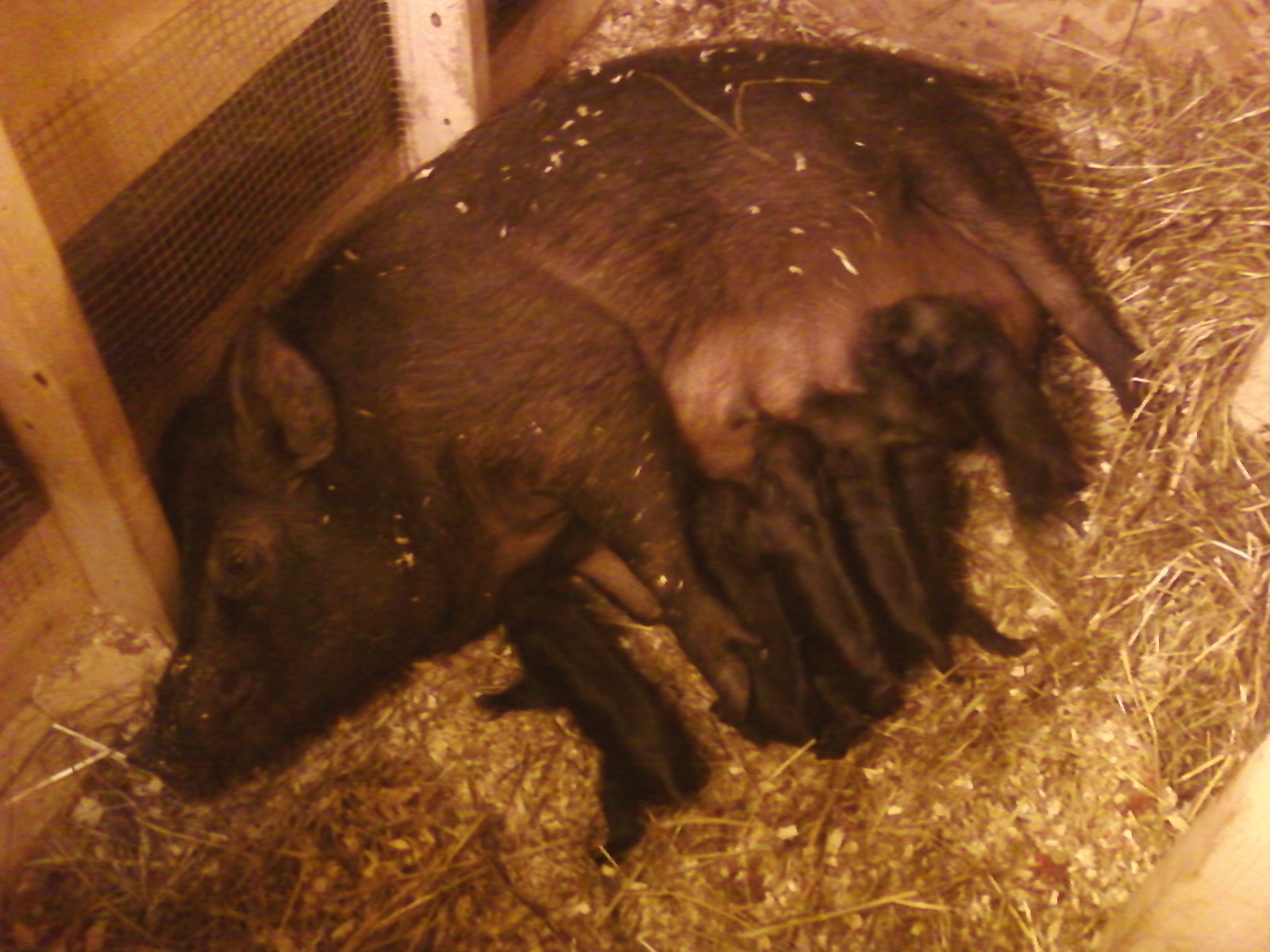
The Willful Pig

After reading one too many books on the horrors of our modern commercial pork production but yet decidedly attached to bacon with my eggs, I decided I needed to add pigs to the family farm.

After careful research and many visits to farms and zoos housing heritage breed pigs, I decided American Guinea Hogs were the choice breed. American Guinea Hogs are excellent foragers, have a friendly disposition and are great mothers. They are cute, black and small, the perfect homesteading pig.


I purchased a registered breeding pair. The thought of two full grown pigs in my Hyundai Santa Fe made the sellers shutter, so they graciously offered to transport them to me in a horse trailer. Although in the pig world, Guinea Hogs are small, a full grown boar still weighs around 200lbs. Not easy to lift in a dog crate.

The pigs arrived on a rainy Saturday morning in late March. The male sauntered out of the trailer and into the pen where he promptly laid down to take a nap. The female had other ideas.
She charged through the hog panel set up to divide them in the trailer, pushed aside two grown men and took off. At this point I was told the gilt was not used to any human handling as she had been raised by her mom in the field and that catching her might prove tricky.

What an understatement. No amount of food bribes seemed to hold her interest long enough to get her into the pen. The farmer, frustrated his “drop off” delivery was turning into a morning long endeavor, tried everything he could think of to get her into the pen. But, the harder we tried, the more stubborn she became. She would race around the yard, across the cornfield, across the road into the neighbor’s field, then back across the road. She would circle the pen, and then take off back across the road.

Soon the neighbors showed up to help and we had six people all trying to get this pig into the pen. We built temporary panels to try to funnel her into the pen, we had lassoes to try to rope her legs, we tried every delicious pig treat we could think. Nothing worked. She was determined to elude capture even if it meant hunger, thirst and exhaustion.

One by one the helpers gave up. Hours of chasing a crazed pig through muddy fields was both tiresome and frustrating. Around 3:00pm, the gentleman who delivered the pigs informed me he was very sorry but there was nothing he could do and he needed to leave. The last helper, my daughter stayed true for a bit and then even she gave up and went into house.

I found myself left alone with a loose pig. By now the sun had come out and warmed the early spring air. I followed her into the neighbor’s pasture where in complete exhaustion she laid down, her head resting on the ground, her eyes wide open looking at me.

I sat down a few feet from her. I slowly crept up to her and petted her on the head. She smiled, rolled over and fell sound asleep. I sat there petting her thinking, now what? In this Thomas Hardy moment, I decided to enjoy the time in the pasture with my new pig. So there we were napping in the sun snuggled up on the cold March ground wondering what would happen next.

I woke up about an hour later with her still sleeping by my side. I looked at her- so peaceful in the twilight and decided to name her Tess, thinking of the stubborn, willful, yet idyllically beautiful peasant girl in Tess of the d'Urbervilles.

Cold and hungry, I decided to give up. She would have to spend her first night alone outside. If she got hit by a car or ran away never to return, I had to accept that fate. I pet her one last time, said good night and started walking back across the field toward the house.


Much to my surprise, Tess followed. As I neared the pen, the male started making grunting sounds, to which Tess seemed to respond. I thought to myself, there is no way it can be this easy, but I decided to give it one last try. I led the male into the shelter, blocked the door and opened up the pen gate. I then stepped aside as Tess sauntered into the pen, waited for me to open up the door to the shelter, went inside and laid down next to her new mate. I closed the gate and said “Goodnight,” exhausted, but relieved the ordeal was over and she would be safe for the night.

After a whole day of chasing, hours of stress and anxiety for all parties involved, Tess had accepted her new home and I accepted that raising American Guinea Hogs was going to offer much more then fresh pork for the table.

Wednesday, November 2, 2011

Starting with Chickens

Chickens are one of the most rewarding suburban farm endeavors. They are inexpensive and require minimal labor to keep, yet offer a tremendous amount of entertainment, great learning opportunities and delicious eggs. You can supply your family with eggs year round with just a small flock of four or five hens.  In addition to the practical rewards, in keeping chickens you will learn first hand the many idioms of our agrarian culture.

Pecking order, hen pecked, don’t count your chickens before they hatch, scratching out a living, mother hen. When living with chickens these sayings all become real and one gains a much deeper understanding of how these saying have become part of our collective cultural language.

After having had chickens for a couple years, we decided to indulge an older hen who had gone broody and allow her to sit on a nest of eggs. For those unfamiliar to the chicken scene, a broody hen is one who stops laying eggs and instead wants to sit on them to incubate and hatch out a little chicken family.

Now this sounds normal enough, but it is actually a bit more complicated. Most people who are keeping chickens are doing so for the eggs. Thus when a hen goes broody, on a “real” egg farm, this hen would be destined for the stew pot.

Over the years, through the commercialization of farming with need for efficiency and productivity, many of the modern breeds of chickens have long since lost their natural mothering skills. The “best” breeds are those that do not go broody. Rather the eggs are incubated and hatched artificially in an environment where all the optimum egg hatching conditions can be met. Thus, many breeds of chickens are quite unsuccessful at hatching and raising chicks. They might go broody, but only sit for a few days and then decide scouring the yard for treats is a more interesting pastime. Or, she might sit until they hatch but them abandon them at birth or simply ignore them after a few days.

Left without human interference, a hen will lay an egg every day or so until she has a clutch. (A collection of 5 to 10 eggs) Once she feels she has a clutch, she will sit for twenty one days keeping the eggs warm. She will leave the nest for short periods to eat and drink, but never long enough for the inside of the eggs to cool.

In a coop with several hens and a caretaker who collects eggs everyday, the natural course for reproduction becomes a challenge for the hen. She thinks she has a clutch and then “poof” her eggs are gone! She makes a nest and then three other chickens lay their eggs in the same nest. Almost a clutch in just three days…then “poof” her eggs are gone again. At some point she will get crabby and really cause a ruckus when the eggs are collected, and then eventually she gives up and just sits anyway, eggs or not! When a hen reaches this level of desperation in her attempt to hatch a family, she has gone “broody.” It is too heart wrenching to just not give her some eggs. 

Small backyard farmers who relish the convenience of “free incubation” and enjoy watching a mother hen with her brood in the barnyard have begun to ensure the continuation of many heritage breed birds who might not lay as many eggs, but have other useful qualities, such as foraging and raising their own young.

All the chickens we breed on our farm are of the heritage sort. I love seeing the circle of life in all my animals and my chickens are no exception. So, we stopped collecting from her nesting box and let mama hen sit on 6 eggs and waited to see if the memories from her ancestors would serve her in her quest for motherhood, as she herself had been born in a hatchery and came from a long line of hatchery birds.

After twenty one days, we checked the nesting box and much to our great surprise and excitement there was a fluffy little chick tucked in its mother’s wing. When a chick hatches it absorbs the yolk sack (the yellow part of the egg) allowing it to survive up to 3 days without any food or water. For modern poultry enthusiasts, this is fabulous as it allows day old chicks to be shipped via the US Postal Service, a service they have offered since the early 1900’s. In a natural setting this is useful because not all babies are born at the same time. This allows the mother to sit for a couple of days on yet to hatch eggs, without jeopardizing the health of the chicks that have already hatched.

After two days, mama hen had three babies following her around the yard. If any of the other hens, or rooster, or dog tried to get anywhere near the babies she was right there to scare them off. If a chick wandered too far and started to cheep, she was right there showing it the way back to the others. All day she watched those chicks, keeping them warm under her wings, or showing them the best places in the yard for treats. Then one day about 12 weeks later, she was done. Her babies were grown and she went back to laying her eggs. The babies had a hard time adjusting to the abandonment, but mama hen had done her job well.

Now, when I hear the expression “Mother Hen” in reference to an over protective mother, I understand what they mean, but my daughter and I always laugh to ourselves, because we know that although a hen’s dedication is unwavering, it is also very short lived!

Tuesday, November 1, 2011

Musings of a Farm Dreamer

How many times have you passed by a picturesque farm house with a majestic red barn surrounded by lush green pasture and dreamed of knowing that life?  I used to fall asleep at night imagining what it would be like
to immerse myself and my family in the agriculture heritage of our past.

A time when the dinner on the table represented an entire families’ labor and the bounty of a harvest was truly a joyful celebration of survival and fellowship. I longed to have the seasons represent a true and meaningful connection with my life, not simply a change in weather.

The nostalgic fantasy of the farm filled my imagination for many years, as I know it does for many. Why would any sound of mind suburbanite dream of adding the responsibility of 24/7 farm animals and food production to an all ready overfilled schedule? Most dismiss the idea and let the dream pass as the barn and farmhouse fade from view. But for some, myself included, the desire to participate in “the life” becomes too great, so we find ourselves knee deep in the realities of small scale farming and animal husbandry.

For me, it started with chickens. First came the chicken palace, a charming structure sided with cedar shakes, roofed appropriately with architectural shingles, insulated and then wired for the birds’ winter comfort. I then promptly planted the entire perimeter with an impressive array of perennials, the perfect finishing touch for my feathered friends abode.

I then promptly placed my order for 25 pullets and hoped I would be a worthy caretaker for my day old chicks, which would arrive via the United States Postal Service.

A year later I had happy, laying hens who all heartedly enjoyed eating the perennial garden.  Contentedly unaware of my human aesthetical preference for their yard, the chickens then continued their satisfaction by digging up all the roots during their dust baths in the skeletal remains of the once stunning perennial bed.

Despite the blow to my beautiful chicken yard, my girls did present me, as appreciation for my efforts, a colorful basket of eggs in which I know even Martha Stewart would have been proud! I also enjoyed hours of entertainment as I watched my flock peck around my yard clucking and squawking as they went about their predictable routine.

Since those early days with the chickens, my farm life has become increasing more complex. However, if I am overwhelmed with all that life is presenting me, I still to this day can just take a deep breath and go watch the chickens. It never fails to ground me and fill me with an overwhelming sense of peace.

For those that are still just dreaming the farm dream, I am hear to tell you suburbanites’ can enjoy, if only a very small piece, the nostalgic farm dream. Even just a few hens, offering your family their fresh eggs, in exchange for a few moments of your time in the morning- to let them into the sun, give them food and water, and in evening to close them back into the coop ensuring their safety at night can share the circle of life in a real and meaningful way. Even just a few hens are enough to help remind us of the complex cycle nature requires for something a simple as an egg.

Over the last few years, although I love my animals and the lessons they have taught me and my family, I have felt frustrated by the small difference my farm can make in the context of larger issues which weigh heavy on my heart. For example, I would love it if as a society we did not rely of factory farms. I wish more country homes had a few chickens in the yard and I wish my experiences could help move us toward a future filled with more of my neighbors able to share the joy in the agricultural practices of our past.

 My family and friends, who listen tirelessly to my rants about the challenges of small scale food production and our society’s diminishing first hand knowledge of even the most basic farm activities, are amused by my crazy animal stories.  They are sometimes in awe of how my stories make them realize just how far removed they are from the realities of food production. Upon reflecting on this interest in hearing the farm adventures, I felt a glimmer of hope in my ability to further my causes beyond the boundaries of my small farm.

I could share with you, the suburban farm dreamers, my journey. My bumbling, error filled misguided, yet hugely rewarding journey in re-connecting with our agrarian heritage. Unlike our farming ancestors who learned their skills from parents, grandparents, uncles and aunts, many new to farmers have to learn from the Internet, YouTube and books. I feel a voice of encouragement from another “farming newbie” might be helpful, or at least entertaining.

For some my tales might provide the confidence to make the dream of owning goats and making cheese or raising chickens for meat or eggs a reality. For others, living the tale vicariously might raise awareness on what it really takes to bring the food you eat to the table. This knowledge is valuable, whether you are the one mucking the pig pen or not because change only happens when we collectively care and we can only care about that which we know. In writing this column, it is my goal through the simple stories of my farm life to help you know just a bit more about what our great grandparents and grandparents knew as a course of life, that it doesn’t take a rooster for a chicken to lay an egg, but it does if you want a chick!